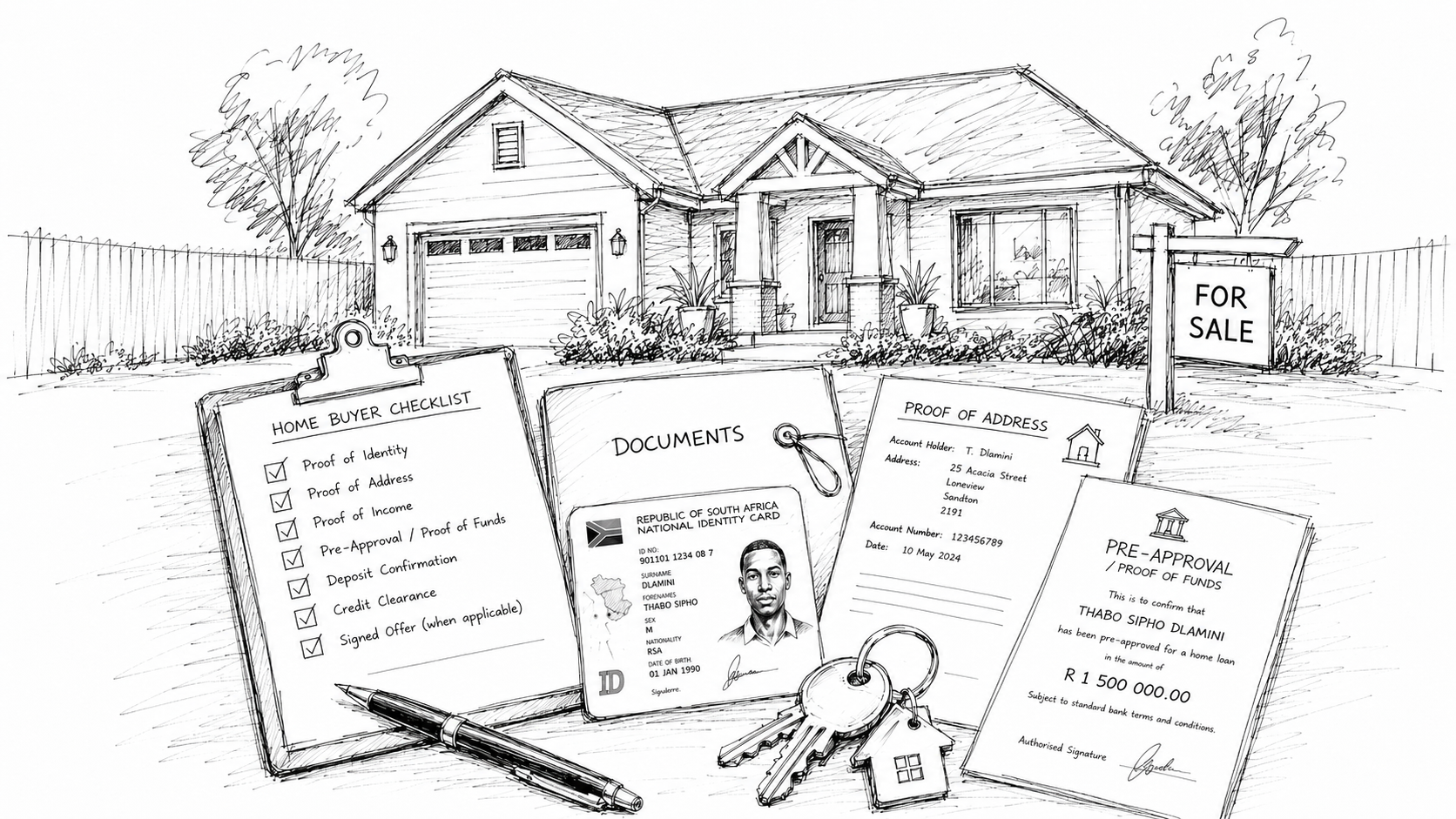
Ready to Make an Offer? Don’t Let Paperwork Slow You Down
When you make an offer on a property, it is not only the purchase price that matters. You will also need to provide a few important documents so that the estate agent, bond originator, bank and attorneys can confirm who you are and start the process correctly.
This is mainly because of FICA requirements. In simple terms, FICA means that the people involved in the transaction must verify your identity, where you live, and sometimes how the purchase will be funded. It is not there to make life difficult. It is there to protect everyone involved and to make sure the transaction is handled properly.
Your estate agent also needs to know who they are working with. Before an offer can be processed and presented properly, the estate agent needs the correct information about the buyer and how the purchase will be funded. This helps the agent present your offer properly and gives the seller more confidence in the transaction.
The good news? Most of the documents are simple. If you prepare them early, the buying process can feel much less stressful and much more organised.
1. Your Identity Document
The first document you will usually need is a copy of your South African ID document or smart ID card.
If you are not a South African citizen, you will usually need a valid passport and any other documents required by the bank, estate agent or attorneys.
If you are buying with another person, such as a spouse or partner, they will also need to provide their documents.
2. Proof of Residential Address
Because of FICA requirements, you will also be asked for proof of your residential address.
This is usually a recent document that shows your name and physical address. Examples may include a municipal account, a bank statement showing your name and address, a lease agreement or another accepted proof of residence.
In most cases, this document should not be older than three months.
3. Marital Status Documents
Your marital status is very important when buying property. It can affect how the property is registered and whether your spouse needs to sign certain documents.
Depending on your situation, you may need to provide:
Marriage certificate
Antenuptial contract, if you are married out of community of property
Divorce order, if you are divorced
Death certificate of a late spouse, if you are widowed
If you are married in community of property, your spouse will usually need to be involved in the transaction, even if the property is being bought in only one name.
4. Income Tax Number
The transferring attorneys will usually require your South African income tax number.
This forms part of the transfer process and may be needed when the attorneys deal with SARS. It is a good idea to have your tax number ready early, especially if you have not used it recently.
5. Proof of Income, Affordability or Financial Ability
If you are applying for a home loan, your bond originator and the bank will need proof of income to assess affordability. The bank needs to see that you can afford the monthly bond repayment.
If you are permanently employed, you will usually need:
Your latest payslip
Sometimes your last three payslips
Three months’ bank statements
Details of your monthly income and expenses
If you earn commission, overtime or irregular income, the bank may ask for extra documents.
Your estate agent may also need to understand your financial position before presenting your offer to the seller. This does not always mean handing over every private financial document to the agent. It means the agent must have enough information to show that the offer is realistic and that the buyer is financially able to proceed.
This does not mean the agent is judging you or being difficult. The agent has a responsibility to make sure that the buyer is properly identified, that the offer is realistic, and that the seller is not entering into an agreement that may later fall apart because the buyer cannot perform.
If you are buying the property without a bond, this becomes even more important. In a cash transaction, there is no bank involved to assess affordability or confirm the buyer’s financial ability. The estate agent may therefore request proof that you have access to the necessary funds before presenting the offer.
Having this information ready helps the agent present your offer properly and gives the seller more confidence that you are a serious and capable buyer.
6. Documents for Self-Employed Buyers
If you are self-employed, the bank will usually need more detailed financial information. The estate agent may also need enough information to understand how the purchase will be funded, especially if you are buying cash or paying a large deposit.
This may include:
Personal bank statements
Business bank statements
Financial statements
A letter from your accountant confirming your income or drawings
Proof of business registration, where applicable
Self-employed buyers should try to prepare their documents as early as possible, as these applications can take a little longer for the bank to assess.
7. Proof of Deposit or Cash Funds
If you are paying a deposit, or if you are buying the property cash, you will usually be asked to provide proof that the funds are available.
This can often be shown with a bank statement, investment statement or a letter from your bank or financial institution.
In a cash transaction, proof of funds is especially important. Because there is no bond approval process, the estate agent and seller need some comfort that the buyer can actually pay the purchase price.
The estate agent and transferring attorneys may also need to ask for information about where the funds come from as part of FICA and anti-money-laundering compliance. The level of information required can depend on the transaction, the amount involved and the risk assessment.
This is not meant to be invasive. It is part of making sure the transaction is handled correctly and that all parties are protected.
Any financial documents provided should be handled confidentially and used only for the property transaction and compliance purposes.
8. Signed Offer to Purchase
Once your offer is accepted by the seller, the signed Offer to Purchase becomes one of the most important documents in the transaction.
The bank will need it if you are applying for a bond, and the transferring attorneys will use it to begin the transfer process.
The Offer to Purchase sets out important details such as:
The purchase price
Deposit amount
Bond amount, if applicable
Occupation date
Suspensive conditions
Fixtures and fittings
Special conditions of the sale
It is important to read the Offer to Purchase carefully before signing, because it becomes a binding agreement once accepted by the seller.
9. Bond Approval Documents
If you are buying with a bond, there will also be documents from the bank and bond attorneys once your loan is approved.
These documents form part of the bond registration process and must be signed before the property can be transferred into your name.
10. Company or Trust Documents, If Applicable
If the property is being bought in the name of a company or trust, additional documents will be required.
These may include:
Company registration documents
Trust deed
Resolutions giving permission to buy the property
Details of directors or trustees
FICA documents for the people involved
Buying in a company or trust can be more complex, so it is best to confirm the requirements with the attorneys early in the process.
A Simple Buyer’s Checklist
Before making an offer, try to have the following ready:
ID document or passport
Proof of residential address
Marital status documents
Income tax number
Payslips or proof of income, if applying for a bond
Bank statements, where required
Proof of deposit or cash funds
Bond pre-approval, if available
Final Thoughts
Buying a home is much easier when your paperwork is ready from the start.
Delays often happen when buyers only start looking for documents after the offer has already been accepted. By preparing early, you help your estate agent, bond originator, bank and attorneys move the process forward more smoothly.
A little preparation can save a lot of stress later.
So, before you fall completely in love with your dream home, make sure your paperwork is ready to go. It may not be the most exciting part of buying property, but it is one of the most important.